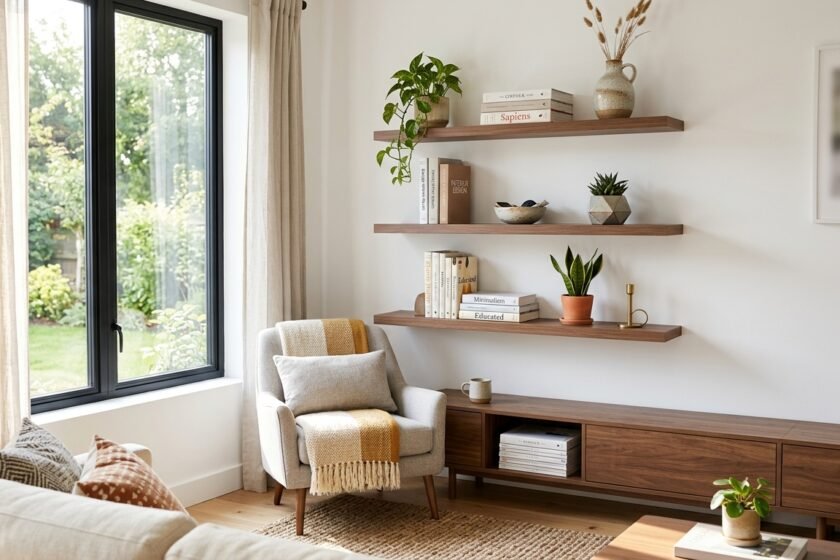
Floating shelves can add display space, storage, and personality without taking up the floor area a bookcase requires. They work especially well in living rooms where a blank wall needs definition, a small collection needs a home, or a media area needs a lighter alternative to a large cabinet. The right arrangement depends on the wall, the shelf’s purpose, and how much visual weight the room can comfortably hold.
This guide explains how to choose, measure, arrange, install, and style floating shelves in a living room. Use the ideas as a planning tool rather than a strict shopping list: the most successful shelf wall is the one that fits your furniture, storage needs, lighting, and everyday habits.
Quick decision guide
| Your goal | Best starting arrangement | What to prioritize |
|---|---|---|
| Display a small collection | One long shelf or two aligned shelves | Negative space and varied object heights |
| Add useful storage | Deeper shelves in a vertical stack | Weight rating, access, and secure installation |
| Fill a narrow wall | Short staggered shelves or a vertical column | Clearance from doors and circulation paths |
| Lighten a media wall | Balanced shelves beside or above the screen | Cable planning and visual restraint |
| Style a small room | One shallow shelf with a few objects | Scale and an uncluttered center of the room |
Choose the right shelf material and finish
Wood shelves bring warmth and are easy to coordinate with flooring, tables, or cabinetry. A painted shelf can blend into the wall and make the display feel lighter, while metal shelves suit industrial or contemporary rooms. Glass and acrylic create the least visual interruption but may require more frequent cleaning and careful placement of breakable objects.
Match the finish to the room’s existing visual language. Dark wood can anchor a pale wall, natural wood softens a modern room, and a wall-colored shelf can make a narrow space feel less busy. If the room already has several wood tones, repeat one of them rather than introducing a fourth finish.
Measure before drilling
Start by measuring the wall width, the height of nearby furniture, and the distance to doors, windows, switches, and artwork. Mark the proposed shelf with painter’s tape so you can view its size from the sofa and from the room entrance. This simple test often reveals that a shelf is too long, too deep, or too close to a doorway.
Above a sofa, leave enough visual breathing room between the back of the furniture and the shelf. The exact clearance depends on the furniture and the shelf system, so follow the manufacturer’s installation guidance and make sure people can sit, stand, and walk without brushing against the display.
For several shelves, sketch the arrangement at full width. Decide whether the left and right edges should align, stagger, or create a deliberate stepped pattern. Measure the objects you plan to display before choosing a shallow shelf that cannot hold them safely.
Floating shelf layouts by wall type
Above a sofa
One long shelf can echo the width of the sofa and create a calm horizontal line. Style it with a larger central piece and smaller objects toward the ends, or use two shorter shelves with an offset arrangement. Avoid placing too many hard, heavy-looking objects directly over the seating area.
Beside a fireplace or media unit
Shelves can balance a fireplace or television when the wall feels visually heavy on one side. Use matching or related finishes, but do not force perfect symmetry if the architecture does not support it. Keep heat sources, vents, and electronics in mind, and follow the safety instructions for the fireplace and shelf hardware.
On a narrow wall
Short shelves arranged vertically can use a narrow strip of wall without narrowing the walkway. Keep the objects compact and leave enough space around the arrangement so it reads as intentional rather than squeezed into leftover space.
In an empty corner
Corner shelves turn an overlooked area into a small display or reading nook. Use fewer objects than you would on a straight wall because the corner already creates visual activity. A plant, lamp, or small stack of books can make the arrangement useful as well as decorative.
Around a television
Use shelves to soften a television wall rather than competing with the screen. One shelf on each side can balance the composition, while a longer shelf below can hold a few low objects and conceal small accessories. Keep the cable route accessible and avoid placing reflective objects where they create screen glare.
How to arrange multiple shelves
Aligned rows
Aligned shelves create a clean, architectural effect and suit minimalist, modern, and orderly rooms. They work best when the shelf lengths and spacing are consistent. Use the arrangement as the calm background and let the objects provide the variety.
Staggered shelves
Staggering shelves adds movement and works well on a blank wall beside a sofa or in an eclectic room. Keep one relationship consistent—such as a shared left edge, shared center line, or repeating width—so the arrangement feels edited.
Vertical stack
A vertical stack emphasizes ceiling height and is useful on narrow walls. Place the heaviest-looking objects on lower shelves and lighter objects higher up. Leave a clear visual path between the stack and nearby artwork or furniture.
Asymmetrical composition
An asymmetrical arrangement can feel relaxed when the visual weight is balanced. A long shelf may be balanced by two shorter shelves, or a dark object may be balanced by several lighter objects on the opposite side. Step back frequently while styling because the composition is judged from across the room.
What to display on living-room shelves
A dependable styling formula combines something tall, something low, something textured, and something personal. Books provide height and color, framed art adds a vertical plane, ceramics bring shape, plants add softness, and photographs or travel objects create meaning. You do not need every category on every shelf.
Vary object height and depth so everything does not form one straight line. Group a few related pieces, then leave open space before the next group. If the shelf feels crowded, remove one object before buying another container or accessory.
Books and paper objects
Use horizontal stacks to create a low platform for a small object, or display a few covers facing outward when the shelf is deep enough. Keep frequently used books within easy reach and reserve delicate editions for stable, less-accessible areas.
Plants
Choose plants according to the available light and the shelf’s weight rating. Trailing plants can soften a hard wall, but keep leaves away from electronics, artwork, and walkways. In low-light rooms, a restrained artificial plant may be more practical than a real plant that will struggle.
Art and mirrors
Lean framed art only when the shelf is deep and stable enough to support it, or secure the frame according to the manufacturer’s advice. A small mirror can reflect light, but check what it reflects from the seated position so it does not double visual clutter.
Personal objects
Travel souvenirs, family photographs, handmade ceramics, and collected objects make a shelf feel specific to the household. Mix personal pieces with quieter items so the display reads as a story rather than a row of unrelated objects.
Style the shelf by room aesthetic
Warm modern
Combine natural wood, neutral ceramics, one soft plant, and a framed print. Keep the palette restrained and let texture provide interest.
Minimalist
Use fewer pieces, repeat one finish, and preserve generous negative space. A single sculptural object can be more effective than a collection of small decorations.
Farmhouse
Layer baskets, weathered wood, simple pottery, and practical objects. Avoid turning every item into a sign or themed accessory; a few authentic materials create a stronger result.
Dark and moody
Use deep wood, black metal, warm lighting, and objects with matte or aged finishes. Add a lighter book cover or ceramic piece to keep the shelf from becoming one dark block.
Colorful eclectic
Choose a small connecting palette, then vary shape and pattern. Repeating one or two colors across books, art, and ceramics keeps an expressive arrangement from becoming visually noisy.
Installation and safety basics
Before installing, identify the wall construction and read the hardware instructions. A shelf mounted into a suitable structural point or with an appropriate anchor is safer than one attached without regard to the wall material. Follow the manufacturer’s stated load limit, distribute weight rather than concentrating it at one end, and check that the shelf is level before styling.
Place heavy or breakable objects low and away from edges. In homes with children or pets, secure vulnerable objects and consider whether the shelf is reachable from furniture. Keep shelves clear of heat, moisture, and electrical hazards, and ask a qualified professional when the wall, wiring, or mounting situation is uncertain.
Common floating-shelf mistakes
- Choosing a shelf before measuring the wall and the furniture beneath it.
- Using a shelf that is too deep for a narrow walkway.
- Overloading the shelf with heavy books or dense objects.
- Filling every inch and leaving no negative space.
- Mixing too many finishes without a connecting color or material.
- Ignoring cables, outlets, heat sources, or the wall’s construction.
- Styling only from close range instead of checking the composition from across the room.
Refresh the display without buying more
Rotate a few objects seasonally, move art between shelves, and change the balance of books, plants, and ceramics. Dust the shelf before rearranging and check that plants are not leaving moisture marks. A simple edit can make the wall feel new without adding more clutter.
Floating shelf FAQs
How many floating shelves should go above a sofa?
There is no universal number. One long shelf often creates a calmer effect, while two or three shelves can provide more storage and vertical interest. Let the wall width, sofa scale, and storage need determine the arrangement.
How do I style floating shelves without making them cluttered?
Group a few objects by height and texture, leave visible empty space, and remove anything that does not support the room’s palette or story. Styling is usually improved by editing rather than adding.
Are floating shelves suitable for a small living room?
Yes, especially when they replace a bulky floor-standing unit. Choose a shallow shelf, keep the arrangement compact, and avoid placing dense objects where they make the room feel visually heavy.
Should shelves match the coffee table or television unit?
They do not need to match exactly, but repeating one finish, undertone, or hardware color creates cohesion. If the room already contains several finishes, a wall-colored shelf may be the quietest choice.
Final planning checklist
Define the shelf’s purpose, measure the wall and furniture, choose a finish that relates to the room, map the arrangement with tape, confirm the wall and hardware requirements, install securely, style in layers, and edit from across the room. A well-planned floating-shelf wall should make the living room more useful and more personal—not simply more full.


Leave a Reply